Page 1 of 3
Download
Get this sheet
SubscriptionOpen any sheet in any course, up to 40 a month, keys included. Or $40 month to month.
$25/mo, billed yearly
SubscribeTry one first: a free Chapter 1 worksheet (PDF, no sign-in).
What's on the worksheet
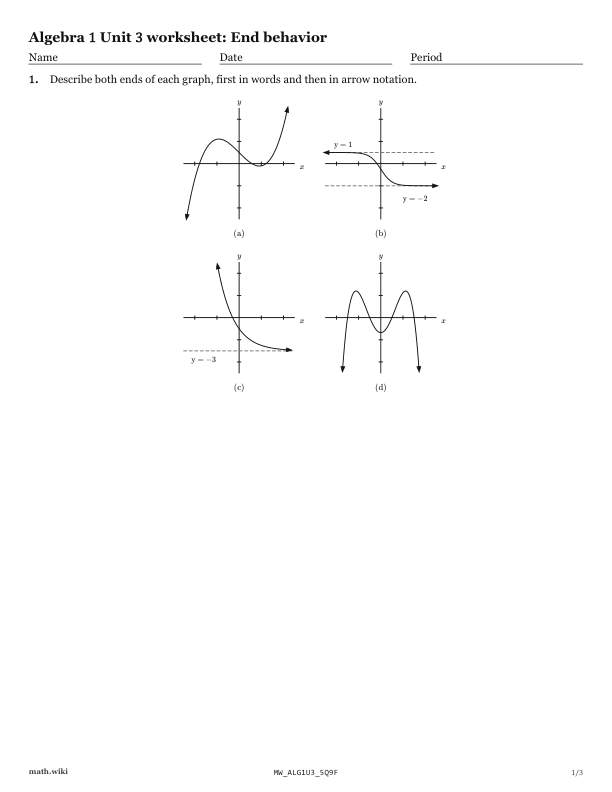
- Describe both ends of each graph in words and in arrow notation.
- Say what is wrong with each student's arrow statement and fix it.
- Describe the end behavior of a related function from the given end behavior.
- Decide whether each described graph is possible, and sketch one if it is.
- Diego's calculator window: explain what the screen hides about the ends of the graph.
- Hannah's tree: use the height model to describe its long-term behavior.
Teach it first
The free lesson teaches it with worked examples and practice problems.
End behavior: the lesson ›More Chapter 3 worksheets: Functions: notation, domain, range, graphs and linear models
- 3.1Function notation in a real situation
- 3.2Evaluating a function at an expression
- 3.3The identity and constant functions
- 3.4Domain and range from a graph
- 3.5A reasonable domain for a real situation
- 3.6End behavior
- 3.7Average rate of change from a table or graph
- 3.8Average rate of change from a formula
- 3.9Linear functions in context
- 3.10Solving f(x) = g(x) with graphs and tables
- 3.11Point-slope form and the line through two points
- 3.12Standard form of a line
- 3.13Modeling with linear relationships