Page 1 of 2
Download
Get this sheet
SubscriptionOpen any sheet in any course, up to 40 a month, keys included. Or $40 month to month.
$25/mo, billed yearly
SubscribeTry one first: a free Chapter 1 worksheet (PDF, no sign-in).
What's on the worksheet
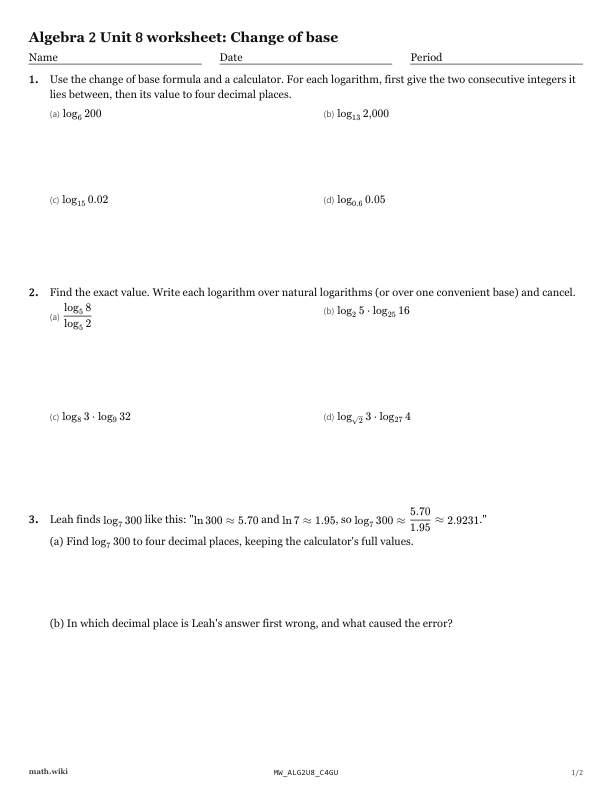
- Use change of base: give the two integers each logarithm lies between and its value to four decimal places.\log_6 200\log_{13} 2{,}000\log_{15} 0.02\log_{0.6} 0.05
- Find each exact value by writing the logarithms over one convenient base.\dfrac{\log_5 8}{\log_5 2}\log_2 5 \cdot \log_{25} 16\log_8 3 \cdot \log_9 32\log_{\sqrt{2}} 3 \cdot \log_{27} 4
- Check Leah's change of base calculation for the logarithm of 300 in base 7.
- Write each logarithm in terms of p, where p is a base 2 logarithm of x.
- Find the whole number bases for which a logarithm of 50 lies between 2 and 3.
- Find the base whose logarithm graph is one third the height of the base 2 graph.
- Show a relationship between logarithms in different bases, for allowed bases a and b.
Teach it first
The free lesson teaches it with worked examples and practice problems.
Change of base: the lesson ›More Chapter 8 worksheets: Logarithms
- 8.1Definition of a logarithm
- 8.2Evaluating logarithms, common and natural
- 8.3Logarithmic scales
- 8.4Laws of logarithms
- 8.5Expanding and condensing logarithms
- 8.6Change of base
- 8.7Graphs of logarithmic functions
- 8.8Solving exponential equations by matching bases
- 8.9Solving by taking a logarithm of both sides
- 8.10Solving logarithmic equations