Page 1 of 2
Download
Get this sheet
SubscriptionOpen any sheet in any course, up to 40 a month, keys included. Or $40 month to month.
$25/mo, billed yearly
SubscribeTry one first: a free Chapter 1 worksheet (PDF, no sign-in).
What's on the worksheet
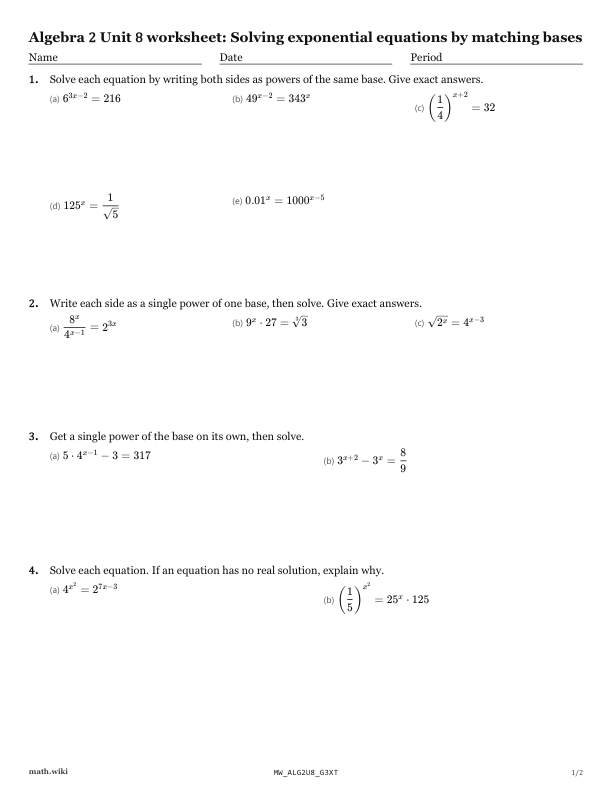
- Solve each equation by writing both sides as powers of the same base.6^{3x - 2} = 21649^{x - 2} = 343^{x}\left(\dfrac{1}{4}\right)^{x + 2} = 32125^{x} = \dfrac{1}{\sqrt{5}}0.01^{x} = 1000^{x - 5}
- Write each side as a single power of one base, then solve.\dfrac{8^{x}}{4^{x - 1}} = 2^{3x}9^{x} \cdot 27 = \sqrt[3]{3}\sqrt{2^{x}} = 4^{x - 3}
- Get a single power on its own, then solve:5 \cdot 4^{x - 1} - 3 = 3173^{x + 2} - 3^{x} = \dfrac{8}{9}
- Solve each equation, or explain why there is no real solution.4^{x^2} = 2^{7x - 3}\left(\dfrac{1}{5}\right)^{x^2} = 25^{x} \cdot 125
- Word problem: the f-number of a camera lens after closing by some stops.
- Check Mei's matching of exponents with base 1 and find every solution.
- Explain each student's mistake, then solve correctly and check.
Teach it first
The free lesson teaches it with worked examples and practice problems.
Solving exponential equations by matching bases: the lesson ›More Chapter 8 worksheets: Logarithms
- 8.1Definition of a logarithm
- 8.2Evaluating logarithms, common and natural
- 8.3Logarithmic scales
- 8.4Laws of logarithms
- 8.5Expanding and condensing logarithms
- 8.6Change of base
- 8.7Graphs of logarithmic functions
- 8.8Solving exponential equations by matching bases
- 8.9Solving by taking a logarithm of both sides
- 8.10Solving logarithmic equations