Page 1 of 2
Download
Get this sheet
SubscriptionOpen any sheet in any course, up to 40 a month, keys included. Or $40 month to month.
$25/mo, billed yearly
SubscribeTry one first: a free Chapter 1 worksheet (PDF, no sign-in).
What's on the worksheet
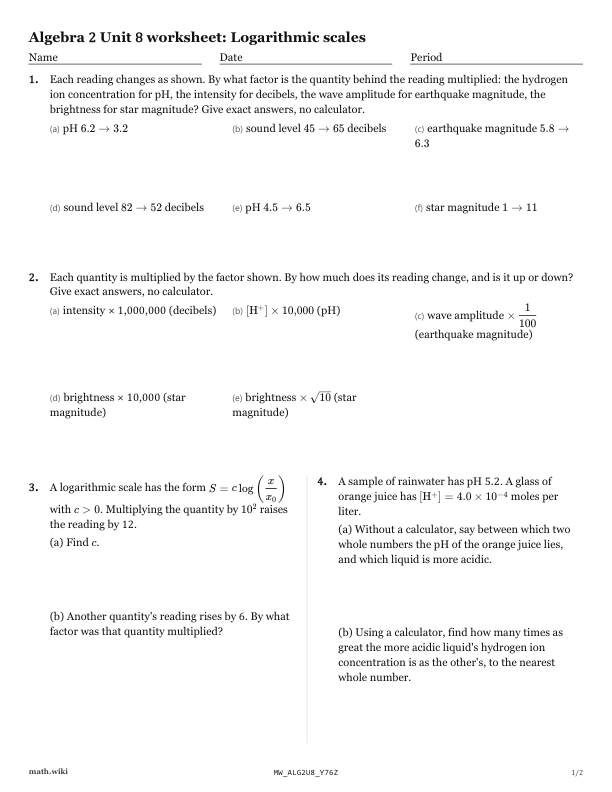
- Find the factor the quantity is multiplied by for each reading change.pH 6.2 \to 3.2sound level 45 \to 65 decibelsearthquake magnitude 5.8 \to 6.3sound level 82 \to 52 decibelspH 4.5 \to 6.5
- Find how much each reading changes, and whether up or down, for a factor.intensity × 1,000,000 (decibels)[\mathrm{H}^+] \times 10{,}000 (pH)wave amplitude \times\, \dfrac{1}{100} (earthquake magnitude)brightness × 10,000 (star magnitude)brightness \times\, \sqrt{10} (star magnitude)
- Find the constant of a logarithmic scale from the reading rise for a factor of 100.
- Compare the acidity of rainwater and orange juice from pH and concentration.
- Compare star brightness from magnitudes, including the North Star.
- Check Mateo's claim about a 75 and a 50 decibel sound.
- Find numbers from positions on a logarithmic axis.
Teach it first
The free lesson teaches it with worked examples and practice problems.
Logarithmic scales: the lesson ›More Chapter 8 worksheets: Logarithms
- 8.1Definition of a logarithm
- 8.2Evaluating logarithms, common and natural
- 8.3Logarithmic scales
- 8.4Laws of logarithms
- 8.5Expanding and condensing logarithms
- 8.6Change of base
- 8.7Graphs of logarithmic functions
- 8.8Solving exponential equations by matching bases
- 8.9Solving by taking a logarithm of both sides
- 8.10Solving logarithmic equations