Page 1 of 2
Download
Get this sheet
SubscriptionOpen any sheet in any course, up to 40 a month, keys included. Or $40 month to month.
$25/mo, billed yearly
SubscribeTry one first: a free Chapter 1 worksheet (PDF, no sign-in).
What's on the worksheet
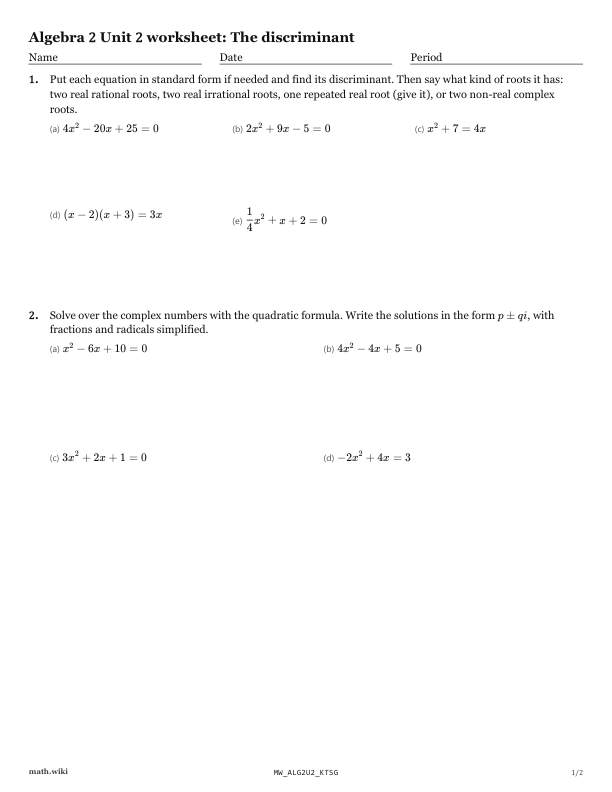
- Find each discriminant and say what kind of roots the equation has.4x^2 - 20x + 25 = 02x^2 + 9x - 5 = 0x^2 + 7 = 4x(x - 2)(x + 3) = 3x\dfrac{1}{4}x^2 + x + 2 = 0
- Solve over the complex numbers with the quadratic formula, answers as p plus or minus qi.x^2 - 6x + 10 = 04x^2 - 4x + 5 = 03x^2 + 2x + 1 = 0-2x^2 + 4x = 3
- Compare Naomi's and Diego's work on 2x^2 - 4x + 7 = 0 and fix the wrong claim.
- Find which values of k give non-real roots, rational roots and more.
- Find where lines through a point meet a parabola, using the discriminant.
Teach it first
The free lesson teaches it with worked examples and practice problems.
The discriminant: the lesson ›More Chapter 2 worksheets: Quadratics and complex numbers
- 2.1Quadratic inequalities
- 2.2Imaginary and complex numbers
- 2.3Adding, subtracting and multiplying complex numbers
- 2.4Conjugates and dividing complex numbers
- 2.5The discriminant
- 2.6Complex roots come in pairs
- 2.7Completing the square
- 2.8Vertex form: reading, converting and graphing
- 2.9Using the quadratic formula