Page 1 of 2
Download
Get this sheet
SubscriptionOpen any sheet in any course, up to 40 a month, keys included. Or $40 month to month.
$25/mo, billed yearly
SubscribeTry one first: a free Chapter 1 worksheet (PDF, no sign-in).
What's on the worksheet
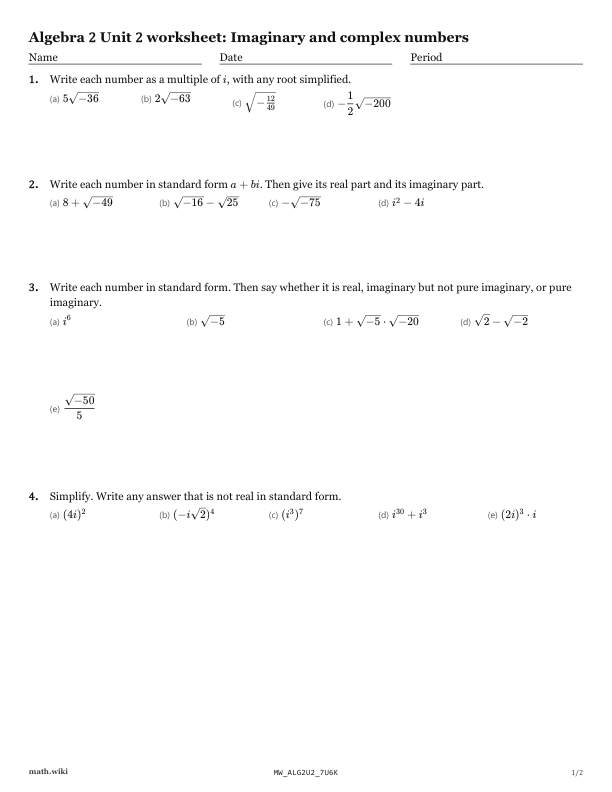
- Write each number as a multiple of i, with any root simplified.5\sqrt{-36}2\sqrt{-63}\sqrt{-\frac{12}{49}}-\dfrac{1}{2}\sqrt{-200}
- Write each number in standard form, then give its real and imaginary parts.8 + \sqrt{-49}\sqrt{-16} - \sqrt{25}-\sqrt{-75}i^2 - 4i
- Write each number in standard form and say if it is real, imaginary or pure imaginary.i^6\sqrt{-5}1 + \sqrt{-5}\cdot\sqrt{-20}\sqrt{2} - \sqrt{-2}\dfrac{\sqrt{-50}}{5}
- Simplify, writing any answer that is not real in standard form.(4i)^2(-i\sqrt{2})^4(i^3)^7i^{30} + i^{3}(2i)^3 \cdot i
- Find the real numbers x and y that match the real and imaginary parts.
- Solve an equation over the complex numbers.
- Decide whether each statement about products of square roots of negatives is true.
- Find a power of i that equals minus i, and show a sum of powers is zero.
Teach it first
The free lesson teaches it with worked examples and practice problems.
Imaginary and complex numbers: the lesson ›More Chapter 2 worksheets: Quadratics and complex numbers
- 2.1Quadratic inequalities
- 2.2Imaginary and complex numbers
- 2.3Adding, subtracting and multiplying complex numbers
- 2.4Conjugates and dividing complex numbers
- 2.5The discriminant
- 2.6Complex roots come in pairs
- 2.7Completing the square
- 2.8Vertex form: reading, converting and graphing
- 2.9Using the quadratic formula