Page 1 of 2
Download
Get this sheet
SubscriptionOpen any sheet in any course, up to 40 a month, keys included. Or $40 month to month.
$25/mo, billed yearly
SubscribeTry one first: a free Chapter 1 worksheet (PDF, no sign-in).
What's on the worksheet
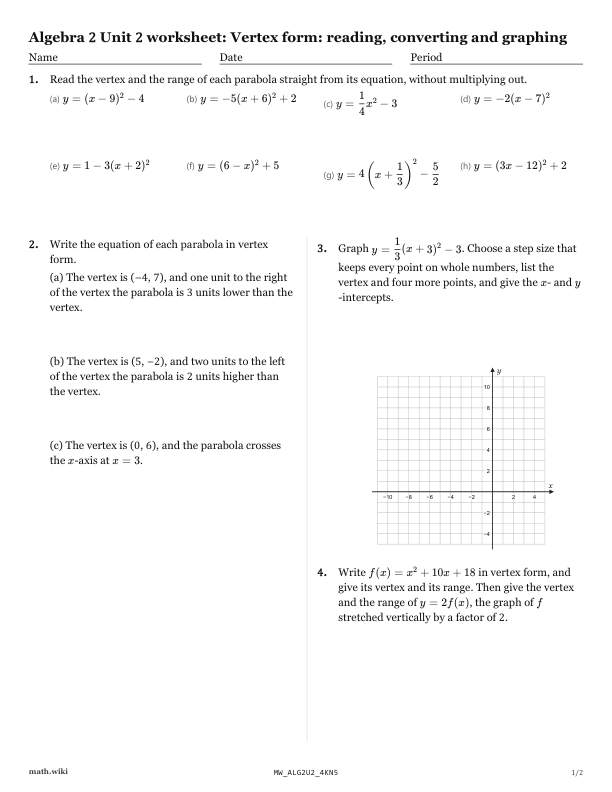
- Read the vertex and range of each parabola straight from its equation.y = (x - 9)^2 - 4y = -5(x + 6)^2 + 2y = \dfrac{1}{4}x^2 - 3y = -2(x - 7)^2y = 1 - 3(x + 2)^2
- Write the equation of each parabola in vertex form from the given description.
- Graph a parabola in vertex form with a table and give its intercepts.
- Write a quadratic in vertex form and find the vertex and range after a vertical stretch.
- Write a quadratic in vertex form and find how many solutions g(x) = t has.
- Describe the slide that moves one parabola onto another, and explain why a different one cannot.
- Write the vertex form of a parabola from its x-intercepts and greatest value.
- Show two parabolas share exactly one point, and explain why this holds for a whole family.
- Word problem: the height of a log flume channel between two crests.
Teach it first
The free lesson teaches it with worked examples and practice problems.
Vertex form: reading, converting and graphing: the lesson ›More Chapter 2 worksheets: Quadratics and complex numbers
- 2.1Quadratic inequalities
- 2.2Imaginary and complex numbers
- 2.3Adding, subtracting and multiplying complex numbers
- 2.4Conjugates and dividing complex numbers
- 2.5The discriminant
- 2.6Complex roots come in pairs
- 2.7Completing the square
- 2.8Vertex form: reading, converting and graphing
- 2.9Using the quadratic formula