Page 1 of 1
Download
Get this sheet
SubscriptionOpen any sheet in any course, up to 40 a month, keys included. Or $40 month to month.
$25/mo, billed yearly
SubscribeTry one first: a free Chapter 1 worksheet (PDF, no sign-in).
What's on the worksheet
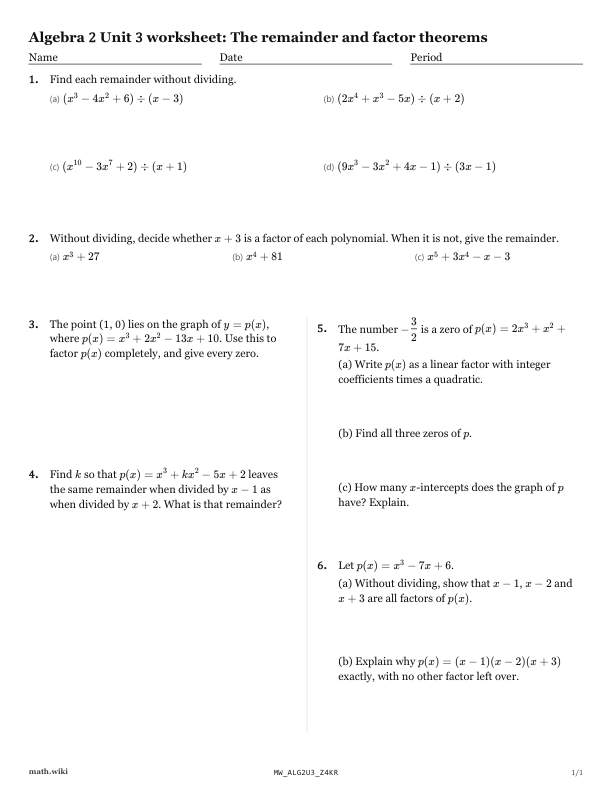
- Find each remainder without dividing:(x^3 - 4x^2 + 6) \div (x - 3)(2x^4 + x^3 - 5x) \div (x + 2)(x^{10} - 3x^7 + 2) \div (x + 1)(9x^3 - 3x^2 + 4x - 1) \div (3x - 1)
- Decide without dividing whether x plus 3 is a factor, and give the remainder if not.x^3 + 27x^4 + 81x^5 + 3x^4 - x - 3
- Use a point on the graph to factor a cubic completely and list its zeros.
- Find k so a cubic leaves the same remainder for two divisors, and give that remainder.
- Use a given zero to factor a cubic and find all three zeros.
- Show three linear factors of a cubic and explain why they are all of it.
Teach it first
The free lesson teaches it with worked examples and practice problems.
The remainder and factor theorems: the lesson ›More Chapter 3 worksheets: Polynomial functions
- 3.1Degree, end behavior and the shape of a polynomial graph
- 3.2Cubic, quartic and higher degree functions
- 3.3Proving polynomial identities
- 3.4Polynomial long division
- 3.5Synthetic division
- 3.6The remainder and factor theorems
- 3.7Zeros and multiplicity
- 3.8Graphing polynomial functions
- 3.9The rational root theorem
- 3.10The fundamental theorem of algebra
- 3.11Building a polynomial from its zeros
- 3.12Modeling with polynomial functions
- 3.13Factoring completely and choosing a strategy