Page 1 of 2
Download
Get this sheet
SubscriptionOpen any sheet in any course, up to 40 a month, keys included. Or $40 month to month.
$25/mo, billed yearly
SubscribeTry one first: a free Chapter 1 worksheet (PDF, no sign-in).
What's on the worksheet
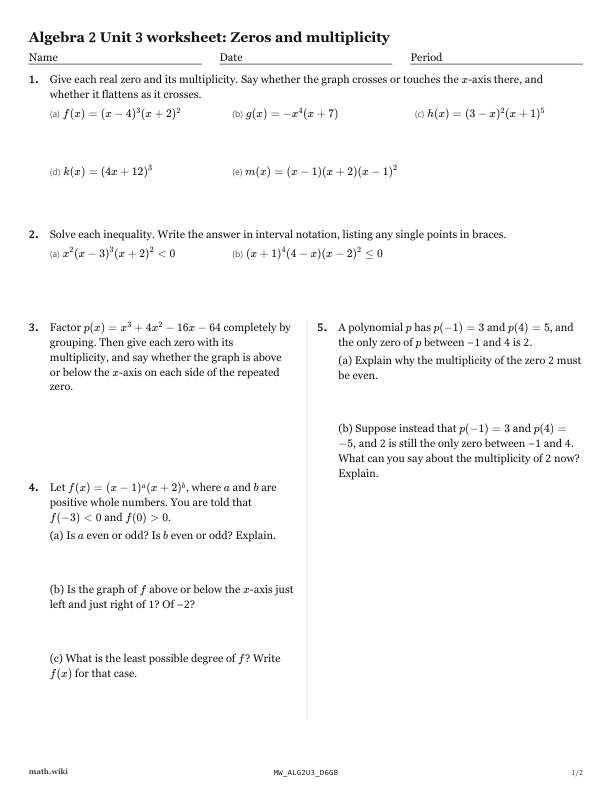
- Give each zero and multiplicity, and say if the graph crosses, touches or flattens.f(x) = (x - 4)^3(x + 2)^2g(x) = -x^4(x + 7)h(x) = (3 - x)^2(x + 1)^5k(x) = (4x + 12)^3m(x) = (x - 1)(x + 2)(x - 1)^2
- Solve each polynomial inequality in interval notation, listing single points in braces.x^2(x - 3)^3(x + 2)^2 < 0(x + 1)^4(4 - x)(x - 2)^2 \le 0
- Factor a cubic by grouping, then give zeros with multiplicity and the graph's position.
- Decide whether the exponents a and b are even or odd from two function values.
- Explain why a zero between two known values must have even multiplicity.
- Read each zero's multiplicity from the graph and give the least possible degree.
- Word problem: Amara's online shop profit rate over twelve months.
Teach it first
The free lesson teaches it with worked examples and practice problems.
Zeros and multiplicity: the lesson ›More Chapter 3 worksheets: Polynomial functions
- 3.1Degree, end behavior and the shape of a polynomial graph
- 3.2Cubic, quartic and higher degree functions
- 3.3Proving polynomial identities
- 3.4Polynomial long division
- 3.5Synthetic division
- 3.6The remainder and factor theorems
- 3.7Zeros and multiplicity
- 3.8Graphing polynomial functions
- 3.9The rational root theorem
- 3.10The fundamental theorem of algebra
- 3.11Building a polynomial from its zeros
- 3.12Modeling with polynomial functions
- 3.13Factoring completely and choosing a strategy