Page 1 of 3
Download
Get this sheet
SubscriptionOpen any sheet in any course, up to 40 a month, keys included. Or $40 month to month.
$25/mo, billed yearly
SubscribeTry one first: a free Chapter 1 worksheet (PDF, no sign-in).
What's on the worksheet
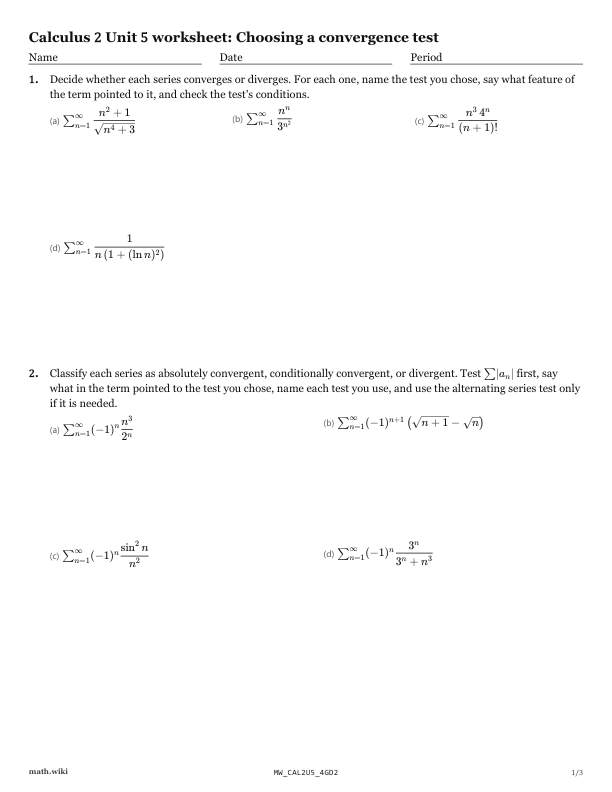
- Decide whether each series converges or diverges.\sum_{n=1}^{\infty} \dfrac{n^2 + 1}{\sqrt{n^4 + 3}}\sum_{n=1}^{\infty} \dfrac{n^n}{3^{n^2}}\sum_{n=1}^{\infty} \dfrac{n^3\, 4^n}{(n+1)!}\sum_{n=1}^{\infty} \dfrac{1}{n\left(1 + (\ln n)^2\right)}
- Classify each series as absolutely convergent, conditionally convergent, or divergent.\sum_{n=1}^{\infty} (-1)^n \dfrac{n^3}{2^n}\sum_{n=1}^{\infty} (-1)^{n+1} \left(\sqrt{n+1} - \sqrt{n}\right)\sum_{n=1}^{\infty} (-1)^n \dfrac{\sin^2 n}{n^2}\sum_{n=1}^{\infty} (-1)^n \dfrac{3^n}{3^n + n^3}
- Let S be the sum of the series below, if it exists.
- Consider the series below.
- Consider the series below.
- For each description, give a series that fits it and show that it does, or explain why no series can fit it.
Teach it first
The free lesson teaches it with worked examples and practice problems.
Choosing a convergence test: the lesson ›More Chapter 5 worksheets: Sequences and series: convergence
- 5.1Convergence of sequences
- 5.2Infinite series and partial sums
- 5.3The geometric series test
- 5.4The nth term test for divergence
- 5.5The integral test and p series
- 5.6The direct and limit comparison tests
- 5.7Alternating series and their error bound
- 5.8Absolute and conditional convergence
- 5.9The ratio and root tests
- 5.10Choosing a convergence test