Page 1 of 2
Download, free
The full Calculus 2 courseEvery lesson in teaching order, with over 160 printables.See the course ›What's on the worksheet
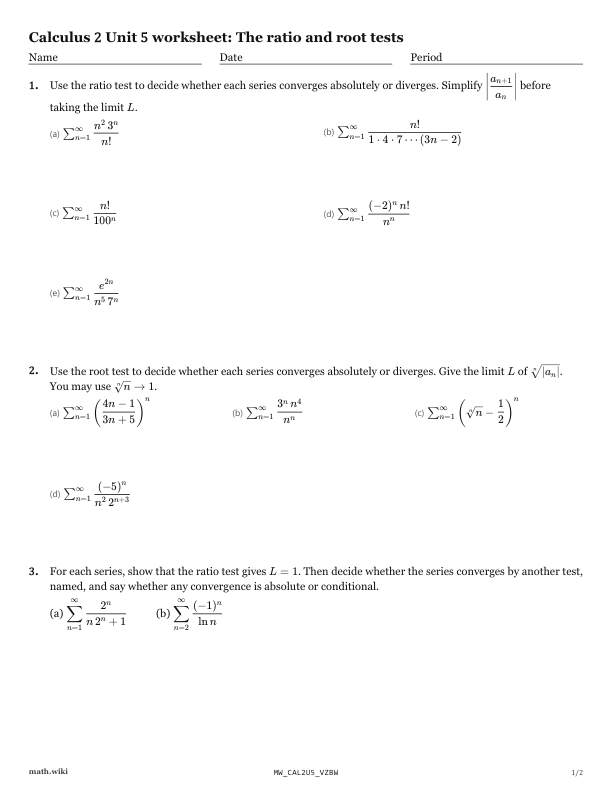
- Use the ratio test to decide whether each series converges absolutely or diverges.\sum_{n=1}^{\infty} \dfrac{n^2\, 3^n}{n!}\sum_{n=1}^{\infty} \dfrac{n!}{1 \cdot 4 \cdot 7 \cdots (3n - 2)}\sum_{n=1}^{\infty} \dfrac{n!}{100^n}\sum_{n=1}^{\infty} \dfrac{(-2)^n\, n!}{n^n}\sum_{n=1}^{\infty} \dfrac{e^{2n}}{n^5\, 7^n}
- Use the root test to decide whether each series converges absolutely or diverges.\sum_{n=1}^{\infty} \left(\dfrac{4n - 1}{3n + 5}\right)^n\sum_{n=1}^{\infty} \dfrac{3^n\, n^4}{n^n}\sum_{n=1}^{\infty} \left(\sqrt[n]{n} - \dfrac{1}{2}\right)^n\sum_{n=1}^{\infty} \dfrac{(-5)^n}{n^2\, 2^{n+3}}
- For each series, show that the ratio test gives L = 1.
- Let S be the sum of the series below, and S_N its Nth partial sum.
- Suppose a_n > 0 for every n and [n]a_n 13.
- Consider the series below, with sum S and Nth partial sum S_N.
Teach it first
The free lesson teaches it with worked examples and practice problems.
The ratio and root tests: the lesson ›More Chapter 5 worksheets: Sequences and series: convergence
- 5.1Convergence of sequences
- 5.2Infinite series and partial sums
- 5.3The geometric series test
- 5.4The nth term test for divergence
- 5.5The integral test and p series
- 5.6The direct and limit comparison tests
- 5.7Alternating series and their error bound
- 5.8Absolute and conditional convergence
- 5.9The ratio and root tests
- 5.10Choosing a convergence test