Page 1 of 2
Download
Get this sheet
SubscriptionOpen any sheet in any course, up to 40 a month, keys included. Or $40 month to month.
$25/mo, billed yearly
SubscribeTry one first: a free Chapter 1 worksheet (PDF, no sign-in).
What's on the worksheet
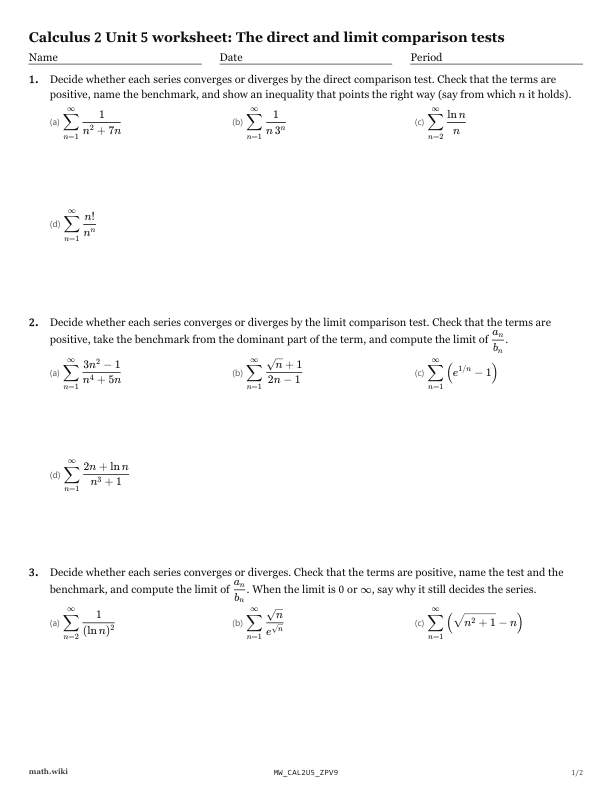
- Decide whether each series converges or diverges by the direct comparison test.\displaystyle\sum_{n=1}^{\infty} \dfrac{1}{n^2 + 7n}\displaystyle\sum_{n=1}^{\infty} \dfrac{1}{n\,3^n}\displaystyle\sum_{n=2}^{\infty} \dfrac{\ln n}{n}\displaystyle\sum_{n=1}^{\infty} \dfrac{n!}{n^n}
- Decide whether each series converges or diverges by the limit comparison test.\displaystyle\sum_{n=1}^{\infty} \dfrac{3n^2 - 1}{n^4 + 5n}\displaystyle\sum_{n=1}^{\infty} \dfrac{\sqrt{n} + 1}{2n - 1}\displaystyle\sum_{n=1}^{\infty} \left(e^{1/n} - 1\right)\displaystyle\sum_{n=1}^{\infty} \dfrac{2n + \ln n}{n^3 + 1}
- Decide whether each series converges or diverges.\displaystyle\sum_{n=2}^{\infty} \dfrac{1}{(\ln n)^2}\displaystyle\sum_{n=1}^{\infty} \dfrac{\sqrt{n}}{e^{\sqrt{n}}}\displaystyle\sum_{n=1}^{\infty} \left(\sqrt{n^2 + 1} - n\right)
- Each argument below has a flaw.
- Let S = _n=1^∞ 1n³ + 1, and let S_N be its Nth partial sum.
- Suppose a_n > 0 for every n and _n=1^∞ a_n converges.
Teach it first
The free lesson teaches it with worked examples and practice problems.
The direct and limit comparison tests: the lesson ›More Chapter 5 worksheets: Sequences and series: convergence
- 5.1Convergence of sequences
- 5.2Infinite series and partial sums
- 5.3The geometric series test
- 5.4The nth term test for divergence
- 5.5The integral test and p series
- 5.6The direct and limit comparison tests
- 5.7Alternating series and their error bound
- 5.8Absolute and conditional convergence
- 5.9The ratio and root tests
- 5.10Choosing a convergence test